Kerime Siller | Product Design
Hanna Vice | User Research
Team
Sept-Dec 2025
Timeline
Physical Product
Platform
Creating an accessible product that empowers disabled
individuals to shower with ease.
Redefining shower accessibility with
Daily Living Labs
AT A GLANCE
Creating a platform that connects designers
with the real needs of disabled individuals
in their daily lives at home.
We created Daily Living Labs to help disabled individuals
find accessible products with ease and request to have
products created to help with their accessibility needs.
As part of the product development team, I created a low-
cost DIY shower accessibility aid that allows the user to
limit their time on task and stay stationary during their
shampoo process.
THE PROBLEM
We researched 40+ different accessibility aids and none of
them met the needs or required a caregiver for those who
struggle with MS (Ataxia), Cerebral Palsy, Parkinson's or other
disabilities that limit upper body movement.
There are no products on the market that
promote autonomy for shampooing.
Users have to struggle to keep their basic hygiene.
Users often get suboptimal results from self-shampooing.
Users often need longer shower times due to disability.
THE QUESTION
How can I create a low-cost shampoo aid that
promotes autonomy for disabled individuals?
Our product team developed 6 products that assist in ADL’s. We initially sorted these concepts into an impact feasibility chart that would help inform our decision making.
50+ concepts created, turned into 6 real products.

After our research team conducted interviews with caregivers and care recipients they found that the solutions created were mainly centering the space of the bathroom but not the activities going inside.
DISCOVERY
We identified 8 ADL barriers; bathing and
grooming being the most underrepresented.
Roll-in shower used by CG-1

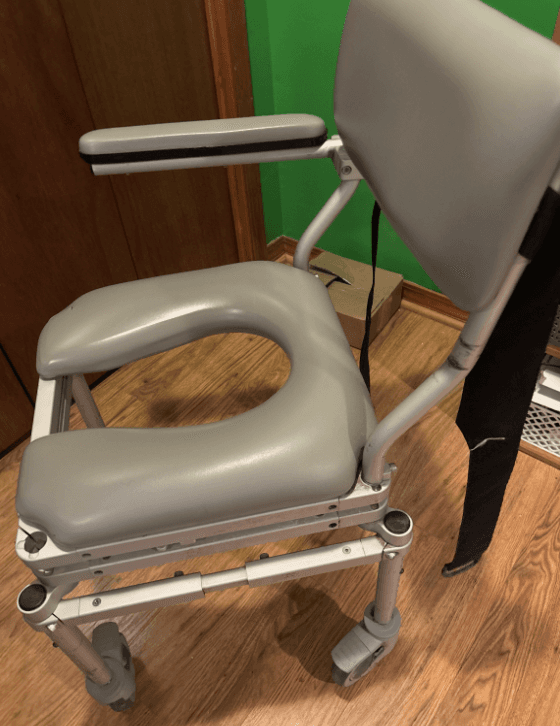
Shower chair used by CG-1
ADL identification

After watching her accessible bathroom tour on Youtube I realized that she still lacked a way to comfortably and easily shampoo her hair due to her cerebral palsy.
I began sketching my concepts.
IDEATION
I became inspired by Sarah Todd Hammer’s
accessible bathroom that was still limited.


I aided in designing our "House of Possibilities" activity for our first workshop. This workshop's main purpose was to inform potential approaches and create a guide for future workshops.
Planning and executing our first workshop.
From my first iteration that was completely manual to my final product that is automatic and adjustable, I have learned that starting complex allows you to fine tune details into something so simple but truly accessible.
Zebreda, from Zebreda makes it work, taught me that accessible tools do not have to be beautiful and complicated, they simply have to work in tandem with the user.
FINAL THOUGHTS
Accessible products do not need to be
elaborate and expensive.
THE FEATURES


Retractable mount with telescoping arm highlights adaptability.
Cup holder allows for easy and quick refills.
Suction cup grip allows for easy install and re-adjustment.
Motion sensor activates automatic dispensing.
Stationary scrub brush allows for easy lathering.
Tool kit streamlines shampooing process.
After 6 user-tested iterations I created a shampoo kit that includes an automatic shampoo dispenser and scalp scrub brush that enables the user to complete their shampoo process in 3 simple steps.
It was imperative that both tools were adjustable to accommodate user’s needs. The motion sensor shampoo dispenser was crucial in creating a truly automatic product.
I designed an adjustable shampoo dispenser
and scrub brush for less than $40 each.
THE SOLUTION
3 steps to the perfect shampoo process.